Your Ad Here
Showing posts with label About Qatar. Show all posts

Saturday, 3 September 2011

December 18 - Qatar National Day Celebration

Qatar marks its National Day on December 18 to commemorate the historic event of December 18, 1878, when Sheikh Jassem bin Mohamed al-Thani, founder of the state, assumed power. Law No. 61  was issued in 2007, announcing the day of Sheikh Jassem bin Mohamed al-Thani’s assumption of power as the National Day. Earlier Qatar used to observe the occasion on September 3, to commemorate September 3, 1971, when it declared independence from being a protectorate of the UK.

Friday, 27 March 2009

Defense

Qatar has a modest defense force of 12,400 military personnel, with 8,500 in the army, 1,800 in the naval forces, and 2,100 in the air force. Military service is compulsory for Qatari males who do not complete secondary school. Qatar played a significant role in the 1991 Persian Gulf War, and served as a central command center for the U.S.-led invasion of Iraq in 2003. Qatar signed a security pact with the United States in 1992, and it depends largely on this ally for protection against major external threats. In the early 21st century the United States shifted its major air operations headquarters for the Middle East from Saudi Arabia to Qatar’s Al Udeid Air Base.

Transportation and Communication

Qatar has a well-developed transportation network. An international airport is located in Doha, and the national carrier, Qatar Airways, serves numerous international destinations. The country’s major ports are at Doha and the industrial center of Mesaieed. In 1995 a new industrial port was completed at Ra’s Laffān to serve the North Field gas project. Qatar has 1,230 km (764 mi) of highways, 90 percent of which are paved. Taxis and automobiles are the principal means of transportation.

Qatar is home to the Al-Jazeera satellite television channel, which is an important source of news and other programming in the country and across the Middle East. Several AM and FM radio stations also broadcast. A range of Arabic- and English-language daily newspapers and weekly or monthly magazines cover political, social, and economic issues. The Qatari press enjoys greater freedom from government censorship than many countries in the region.

Way of Life

Traditional values tend to shape the average Qatari person’s social and cultural life, which remains strongly centered on the family. The father has the dominant role in the family. The place of women is still overwhelmingly the home, but with the government’s active encouragement, women are increasingly entering government and private business employment. Unlike in neighboring Saudi Arabia, gender segregation in the workplace is not strictly enforced in Qatar.

Qataris have used their oil-derived incomes to build new houses with modern amenities, purchase automobiles, and travel overseas. Dress remains largely traditional. In the hot season men wear a loose-fitting cotton cloak called a dishdasha, over which, in cooler weather, they don a bisht, or woolen cloak. Qatari women wear a loose, concealing garment called an abaya, and are frequently seen veiled or wearing a beak-like leather mask called a burka over the face. The Qatari diet features lamb, rice, and local fish. Coffee is not merely a beverage but an important focus of ceremonial and social life as well. Most social recreation is in the home, although increasingly Qataris enjoy eating out and driving in the desert interior. South Asians and other expatriates maintain their own distinctive lifestyles. There are no major tensions between ethnic groups, nor between Sunni and Shia Muslims. The crime rate in Qatar is extremely low and poverty is almost unknown.

Culture

Qatari craftspeople are traditionally known for their jewelry, embroidered clothing, and camel saddles. Graceful Arabian sailboats called dhows are perhaps the best local example of artistic beauty combined with practical purpose. Qatari men perform traditional Bedouin dances on special occasions, such as weddings, and in exhibitions. The country’s theaters and television stations present dramas and other productions. Qatari authors write on themes of local interest, such as the clash of tradition and modernization, and are also known for political and social satires.

The Qatar National Museum (founded in 1975), housed in the palace of a former emir at the eastern end of Doha, presents exhibits on the peninsula’s geology and archaeology and displays of artifacts that illustrate the traditional Qatari lifestyle. Also in Doha, an ethnographic museum in the restored Wind Tower House (built in 1935) demonstrates how traditional Qatari houses were ventilated and cooled before electricity and provides a view of life before the oil era.

Industry

The industrial sector—including mining, manufacturing, construction, and power generation—produces about half of Qatar’s GDP and employs 41 percent of the country’s labor force. Petroleum accounts for much of industry’s share of GDP, but the government has encouraged diversification of the sector. Consequently, numerous new enterprises were established in the late 20th century, including a petrochemical plant, a fertilizer factory, steel and aluminum smelters, a flour mill, and a cement plant. Qatar’s gas and oil reserves power thermal generators that produce enough electricity to meet all of the country’s needs.

Language and Religion

Arabic is the official language of Qatar. English, Urdu, and Farsi are also widely spoken. About 85 percent of the people are Muslims, the majority of the Sunni branch. The non-Muslim minority includes Christians, Hindus, and Buddhists. Qatar’s Sunni Muslims follow the same strict interpretation of Islam as do Sunnis in Saudi Arabia, but its application is somewhat less austere in Qatar. For example, in contrast to Saudi Arabia, women are permitted to drive and non-Muslims may be served alcohol. This strict form of Islam is known to Westerners as Wahhabism (see Wahhabis), but its adherents object to that term and refer to themselves as muwahhidun (unitarians, from al-muwahhid, Arabic for “those who proclaim the unity of God”).

Economy Of Qatar

Petroleum is the cornerstone of Qatar's economy and accounts for more than 70% of total government revenue, more than 60% of gross domestic product, and roughly 85% of export earnings. Proved oil reserves of 15 billion barrels (588,000,000 m³) should ensure continued output at current levels for 23 years. Oil has given Qatar a per capita GDP that ranks among the highest in the world. Qatar's proved reserves of natural gas exceed 7000 km³, more than 5% of the world total, third largest in the world. Production and export of natural gas are becoming increasingly important. Long-term goals feature the development of off-shore petroleum and the diversification of the economy.

Qatar is now the richest country in the Muslim world. Current GDP per capita registered a world record-breaking peak growth of 1,156% in the Seventies. This became quickly unsustainable and Qatar's current GDP per capita contracted 53% in the Eighties. But rising global oil demand helped current GDP per capita to expand 94% in the Nineties. Diversification is still a long-term issue for this over-exposed economy.

This is a chart of trend of gross domestic product of Qatar at market prices estimated by the International Monetary Fund with figures in millions of Qatari Rials.

Currency Qatari riyal
Trade organisations OPEC WTO

Links

State of Qatar Government

The Emir is the ruler of the State. Rule in Qatar is hereditary within the family of Al Thani, whereby power is transferred from father to son. In case no son is available, power is transferred to the person whom chooses within the family of Al Thani.His Highness the emir is the head of Constitutional Authorities, holding both legislative and executive powers. The Emir appoints the prime minister and ministers.

The Council of Ministers (Cabinet), the supreme executive authority in the country, assist implementing the general policies of the State. A 35-member Advisory Council debates economic, political and administrative matters referred to it by the Council of Ministers.


The Constitutional development of Qatar has kept pace with the rapid development and economic growth of the country. The first provisional constitution was issued in 1970, and amended in 1972 upon independence. In April 2003, an overwhelming 96.6% of Qatari voters said "yes" to a draft permanent constitution which became effective of the 8th of June 2005, transforming Qatar into a Democracy. In 2007, parliamentary elections took place in Qatar for the first time in Qatar's history, women was permitted to vote and stand as candidate.

In 1999, free elections were held to form a 29-member Central Municipal Council for the first time in Qatar's history - and women were allowed to vote and run as a candidate.

Amiri Diwan

The official website of the Emir contains interesting information about Qatar, and copies of the Emir's speech. Unfortunately, it does not work on the Firefox browser.

Centre for Geographic Information Systems

Expect a noisy introduction!

Central Tenders Committee

Organises tenders, bids and auctions for Qatar Government Bodies.

E-Government

Check Qatar visa status, renew health cards on-line, check for fines and more.

Endowments and Islamic Affairs

Official Endowments and Islamic Affairs website

Hamad Medical Corporation (Ministry of Public Health)

Hamad Medical Corporation website.

Hukoomi

Government website providing information and services to residents, visitors and businesses.

Ministry of Civil Services and Housing

Arabic only, except for the Labour Law section.

Ministry of Education

(Arabic only)

Ministry of Interior

Ministry of Interior website.

Ministry of Municipal Affairs and Agriculture

Qatar Ministry of Municipal Affairs and Agriculture.

National Council for Culture, Arts and Heritage

Qatar National Council for Culture, Arts and Heritage.

Planning Department

Qatar Planning Department.

Qatar Chamber of Commerce and Industry

Qatar Chamber of Commerce and Industry website.

Qatar Embassy in America

This website contains tonnes of useful information about Qatar.

Qatar Foreign Information Agency

Qatar Foreign Information Agency website.

Supreme Council for Family Affairs

Supreme Council for Family Affairs website.

Supreme Council of Information and Communication Technology

Supreme Council of Information and Communication Technology site.

Supreme Education Council

Qatar Supreme Education Council website.

The Ruling Family

The Emir , His highness Sheikh Hamad Bin Khalifa Al Thani, took over reigns of Power on 27th June 1995.


His Highness
Sheikh Hamad Bin Khalifa Al Thani
Emir of the State of Qatar


On the 5th of August 2003, HH the Emir announced the appointment of his son. HH Sheikh Tamim Bin Hamad Al Thani , as Heir Apparent.


His Highness
Sheikh Tamim Bin Hamad Al Thani
Heir Apparent


The ruling Al Thani family was among a tribal group who settled for a long time at the "Gibrin" oasis in the Southern Najd, before their arrival in Qatar during the 18th century. Initially, they settled in Zubara in the North of Peninsula, moving to Doha only in the mid 19th century.

The name Al Thani is derived froom that of the family's ascestor Thani Bin Mohamad Bin Thani, who was the first Sheikh to rule over Qatar during the mid 19th century. The family is a branch of the ancient Arab Tribe, the Bani Tameem, whose descent can be traced back to Mudar Bin Nizar.

Thursday, 26 March 2009

History

Archaeological evidence shows that human habitation existed in Qatar for many centuries prior to the modern age; however, little is known of Qatar's history until the 18th century. The al-Thani family, forebears of the present rulers, arrived in Qatar then from what is now Sa'udi Arabia. During the same century, the al-Khalifah family, who currently rule Bahrain, arrived from Kuwait.

In 1868, Britain intervened on behalf of the Qatari nobles and negotiated the Perpetual Maritime Truce, signed by Muhammad bin Thani, an accord that terminated the Bahraini claim to Qatar in exchange for a tribute payment. In 1872, however, Qatar fell under Ottoman occupation, and Jasim bin Muhammad bin Thani became Turkish deputy-governor of Qatar. Turkish dominion prevailed until the outbreak of World War I and the subsequent withdrawal of the Turks from the Arabian Peninsula. Qatar thereupon established its independence and, in 1916, Sheikh 'Abdallah bin Jasim al-Thani signed a treaty with the United Kingdom granting British protection in exchange for a central role for the United Kingdom in Qatar's foreign affairs. A 1934 treaty further strengthened this relationship. Commercial quantities of high-quality oil were discovered at Dukhan in 1940, but full-scale exploitation did not begin until 1949.

In 1960, Sheikh Ahmad bin 'Ali al-Thani succeeded his father, who had become too old to rule effectively. Social and economic development during the subsequent decade was disappointing, especially in view of the increasing availability of oil revenues. In January 1968, the United Kingdom announced its intention to withdraw its forces from the Persian Gulf States by the end of 1971. Discussions took place among the Trucial States, Bahrain, and Qatar, with a view to forming a federation. The Trucial States formed the United Arab Emirates, but Qatar could not agree to the terms of the union. On 3 September 1971, the independent State of Qatar was declared. A new treaty of friendship and cooperation was signed with the United Kingdom, and Qatar was soon admitted to membership in the Arab League and the UN.

On 22 February 1972, Sheikh Khalifa bin Hamad al-Thani, the deputy emir and prime minister, seized power in a peaceful coup, deposing his cousin, Sheikh Ahmad. Since his accession, Sheikh Khalifa pursued a vigorous program of economic and social reforms, including the transfer of royal income to the state. On 31 May 1977, Sheikh Khalifa appointed Sheikh Hamad bin Khalifa al-Thani, his son, as heir apparent and minister of defense.

In 1981, Qatar, along with the other Persian Gulf states of Bahrain, Kuwait, Oman, Sa'udi Arabia, and the United Arab Emirates, established the Gulf Cooperation Council (GCC). The GCC attempted to mediate the war between Iran and Iraq, which had erupted in September 1980, but at the same time gave support to Iraq. Qatar's boundary disputes with Bahrain disrupted relations between the two countries in the mid-1980s. In 1991, they agreed to refer their dispute over the Hawar Islands to the International Court of Justice at The Hague. In 1992, there was a minor clash between Qatari and Sa'udi troops over a disputed border. That quarrel was resolved with a boundary agreement signed in Cairo in December 1992.

Qatari forces, although small in size, are active in the collective defense of the GCC and played a helpful role on the allied side in the Gulf War against Iraq.

In 1995, Sheikh Hamad seized power from his father amid a turbulent and secretive attempted coup in February of that year by unknown forces. Sheikh Khalifa, the aging ruler, had spent much of his time before being ousted sailing the Mediterranean on the royal yacht. Also a problem was the aging emir's eccentric method of funding the government, which was to siphon off half of the revenue generated from the country's oil into his personal bank accounts, and pay for government services from those funds. In the late 1980s and early 1990s, the emir felt less inclined to withdraw money than to deposit, and the resulting revenue drain was crippling the economy. When Sheikh Hamad took control of the government, while his father was away on business, the now former emir froze his personal bank accounts, which held, essentially, Qatar's treasury. Estimates of Sheikh Khalifa's personal accounts range from $4–$30 billion.

In 1996, the former emir set up a government in exile in the United Arab Emirates. The hostile transfer of power led to friction among the normally contention-free members of the GCC. Also that year, Sheikh Hamad issued writs demanding that his father turn over control of his assets to the state. Initially, the emir had resigned himself to the loss of revenue, but severe budget constraints caused him to cut government spending and, in order to develop the huge off-shore natural gas reserves the country will rely on in the future, huge infrastructure expenses needed to be made.

In 1999, the former emir still claimed to be the legitimate ruler of Qatar, and his allies within the ruling elite were still a source of problems for Sheikh Hamad. However, Sheikh Hamad has

continued to rule and implement change in spite of outside threats.

In 1999, Qatar supported the Organization of Oil Exporting Countries (OPEC) efforts to increase oil prices by cutting back crude oil production from March 1999 to April 2000. Qatar was also practicing fiscal discipline and creating low-cost efficiencies. The government was developing a tariff structure with a monthly ceiling on water and electricity services, previously free of charge. In addition, plans were in the works to implement a foreign investment code in agriculture, industry, tourism, and education ventures.

Perhaps most striking, Sheikh Hamad was encouraging political openness. In 1999, women voted and ran for office in municipal elections for the first time. A constitutional committee was charged with drawing up a permanent constitution under which Qatar would have an elected parliament. Political openness was even extended to the media as Qatar's satellite news channel, Al Jazeera, broke a previous taboo with an open discussion and criticism of the state funding of the ruling family.

On 16 March 2001, the International Court of Justice (ICJ) resolved a territorial dispute between Bahrain and Qatar over the potential oil-and gas-rich Hawar Islands. The islands were controlled by Bahrain since the 1930s but were claimed by Qatar. Bahrain also claimed the town of Zubarah, which is on the mainland of Qatar. The dispute has lasted for decades and almost brought the two nations to the brink of war in 1986. In its judgment, the ICJ drew a single maritime boundary in the Gulf of Bahrain, delineating Bahrain and Qatar's territorial waters and sovereignty over the disputed islands within. The ICJ awarded Bahrain the largest disputed islands, the Hawar Islands, and Qit'at Jaradah Island. Qatar was given sovereignty over Janan Island and the low-tide elevation of Fasht ad Dibal. The Court reaffirmed Qatari sovereignty over the Zubarah Strip.

During 2002 and into 2003, Qatar, along with the other countries of the Persian Gulf, were confronted with the situation of a potential US-led war with Iraq. On 8 November 2002, the UN Security Council unanimously passed Resolution 1441, calling on Iraq to immediately disarm itself of weapons of mass destruction (WMD) and WMD weapons capabilities, to allow the immediate return of International Atomic Energy Agency (IAEA) and UN weapons inspectors, and to comply with all previous UN resolutions regarding the country since the end of the Gulf War in 1991. If Iraq was found to be in "material breach" of the resolution, "serious consequences" were to result. The United States and the United Kingdom began amassing troops in the region, and by the end of February 2003, the number of troops in the Persian Gulf was approximately 200,000. As of 1 February, there were approximately 3,500 US military personnel in Qatar. In December 2002, a computer-assisted exercise entitled "Internal Look" was carried out in Qatar, involving approximately 1,000 military planners and a mobile command center, which would eventually be staffed by 1,600 US and UK troops. As of March 2003, an aerial command-and-control center was being constructed at Al Udeid, in the event that US forces could not use their control center in Sa'udi Arabia. The Al Udeid air base has the longest runway in the Gulf region (approximately 5,000 m/15,000 ft), and can accommodate nearly 100 aircraft. Operating at Al Udeid in early 2003 was air-to-air refueling of tanker aircraft in support of US-led forces in Afghanistan and to patrol Iraq's southern no-fly zone in the aftermath of the 1991 Persian Gulf War. In December 2002, the United States and Qatar signed a bilateral defense agreement that US Secretary of Defense Donald Rumsfeld stated was not connected to Iraq.

However, Qatar has said it would not act in a conflict with Iraq without UN approval. At an Arab League summit held at Sharm el-Sheik, Egypt, on 1 March, sharp divisions between Arab leaders on the Iraq situation emerged, particularly between Libya and Sa'udi Arabia. However, the leaders issued a declaration expressing "complete rejection of any aggression on Iraq," and called for continuing UN weapons inspections. It also called upon Iraq to disarm itself of WMD and the missiles needed to deliver them. At the summit, some leaders argued war was inevitable and that the countries of the region should prepare for its aftermath; some argued that war could be avoided if Iraq were to comply with weapons inspections; and a third group argued that the summit should issue an unequivocal anti-war declaration.

Demography

The total population is presently in the region of 800,000 and has been increasing at a rate of 9% annually in recent years. Almost 50% of the population resides in the city of Doha, which is the business and administration capital. Most of them are South Asians, Egyptians, Palestinians, Jordanians, and Iranians. About 5,000 U.S. citizens resided there as of 2001.Other population centres include Dukhan on the west coast, Mesaieed and Al Wakra in the South, and Ras Laffan and Al Khor in the North.

Climate

The country has a moderate desert climate with hot summers and mild winters. Winter nights can be cool, but temperatures rarely drop below 7 degrees celsius. Temperature and humidity rise in coastal cities and towns during summer. Rainfall is scarce (average 70mm per year), fallinf on isolated days mainly between October and March.

Required Clothing

Lightweight cottons and linens are recommended during summer months but avoid wearing silk, which sticks to the skin with the humidity. A cardigan is useful for over-cooled malls in the summer and a jacket is a must for cooler evenings during the winter. If you intend to take a camping trip in spring or autumn, you’ll be glad of an extra layer of clothing at night.

Geography


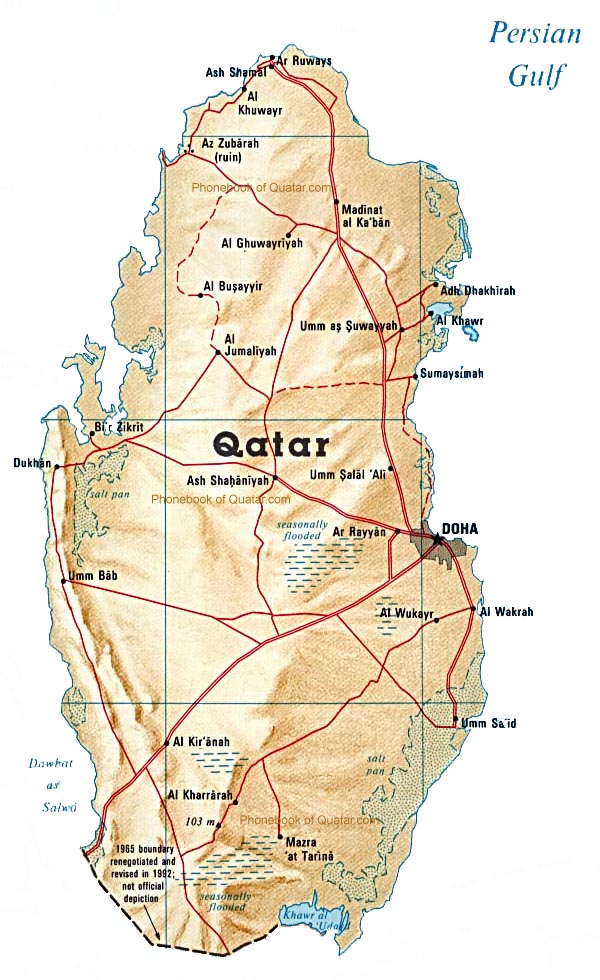
Qatar is a peninsula in the east of Arabia, bordering the Persian Gulf and Saudi Arabia, in a strategic location near major petroleum deposits. Qatar occupies 11,437 square kilometers on a peninsula that extends approximately 160 kilometers north into the Persian Gulf from the Arabian Peninsula. Varying in width between fifty-five and ninety kilometers, the land is mainly flat (the highest point is 103 meters) and rocky. Notable features include coastal salt pans, elevated limestone formations (the Dukhan anticline) along the west coast under which lies the Dukhan oil field, and massive sand dunes surrounding Khawr al Udayd, an inlet of the gulf in the southeast known to local English speakers as the Inland Sea. Of the islands belonging to Qatar, Halul is the most important. Lying about ninety kilometers east of Doha, it serves as a storage area and loading terminal for oil from the surrounding offshore fields. Hawar and the adjacent islands immediately off the west coast are the subject of a territorial dispute between Qatar and Bahrain.

The capital, Doha, is located on the central east coast on a sweeping (if shallow) harbor. Other ports include Umm Said, Al Khawr, and Al Wakrah. Only Doha and Umm Said are capable of handling commercial shipping, although a large port and a terminal for loading natural gas are planned at Ras Laffan, north of Al Khawr. Coral reefs and shallow coastal waters make navigation difficult in areas where channels have not been dredged.

Qatar shares its land border with the United Arab Emirates (UAE), with which in 1993 it continued to have a dispute in the Khawr al Udayd area. The boundary with Saudi Arabia was settled in 1965 but never demarcated. Qatar's northwest coast is fewer than thirty kilometers from Bahrain.

Doha is the capital of the country and the major administrative, commercial, and population center. In 1993 it was linked to other towns and development sites by a system of about 1,000 kilometers of paved roads. Doha's international airport has an approximately 4,500-meter main runway, capable of receiving all kinds of aircraft.

Qatar

Qatar (Arabic: قطر ‎ officially the State of Qatar (Arabic: دولة قطر transliterated as Dawlat Qatar), is an Arab emirate in the Middle East, occupying the small Qatar Peninsula on the northeasterly coast of the larger Arabian Peninsula. It is bordered by Saudi Arabia to the south; otherwise the Persian Gulf surrounds the state. An oil-rich nation, Qatar has the second highest GDP per capita in the world according to the CIA World Factbook .

Qatari Flag


The Flag of Qatar (Arabic: علم قطر‎) has a proportion of 11:28. It is maroon with a broad white serrated band (nine white points) on the hoist side.
The flag was officially adopted on July 9, 1971, although a nearly identical flag (only differing in proportion) had been used since 1949. It is very similar to the flag of the neighbouring country of Bahrain, which has fewer points, a 3:5 proportion, and a red colour instead of maroon. A common explanation of the differences between the two, is simply to distinguish them. A popular but fanciful tale referring to the maroon color and the similarity to the red Bahrain flag, is that maroon is what becomes of red fading in the Gulf sun.